Embracing Art's Next Evolution
The contemporary art world is defined by its radical expansion. It has embraced performance, installation, video art, and conceptual work—forms that pushed far beyond the boundaries of painting and sculpture. And yet, within this "anything goes" landscape, I still sense a strange skepticism when it comes to digital art. It's often treated as a separate category, a technical craft rather than a "high" art form—as if it's too cold, too ephemeral, or too detached from the artist's hand.
This skepticism, to me, feels like a fundamental misunderstanding of what a medium is. A medium isn't a set of rules; it's a vehicle for an idea. The computer, the tablet, and the software are not the artist. They are, quite simply, the most contemporary tools we have for the timeless act of creation.
This text is my exploration of this medium, not as a replacement for traditional forms, but as a necessary and vital part of the contemporary conversation.
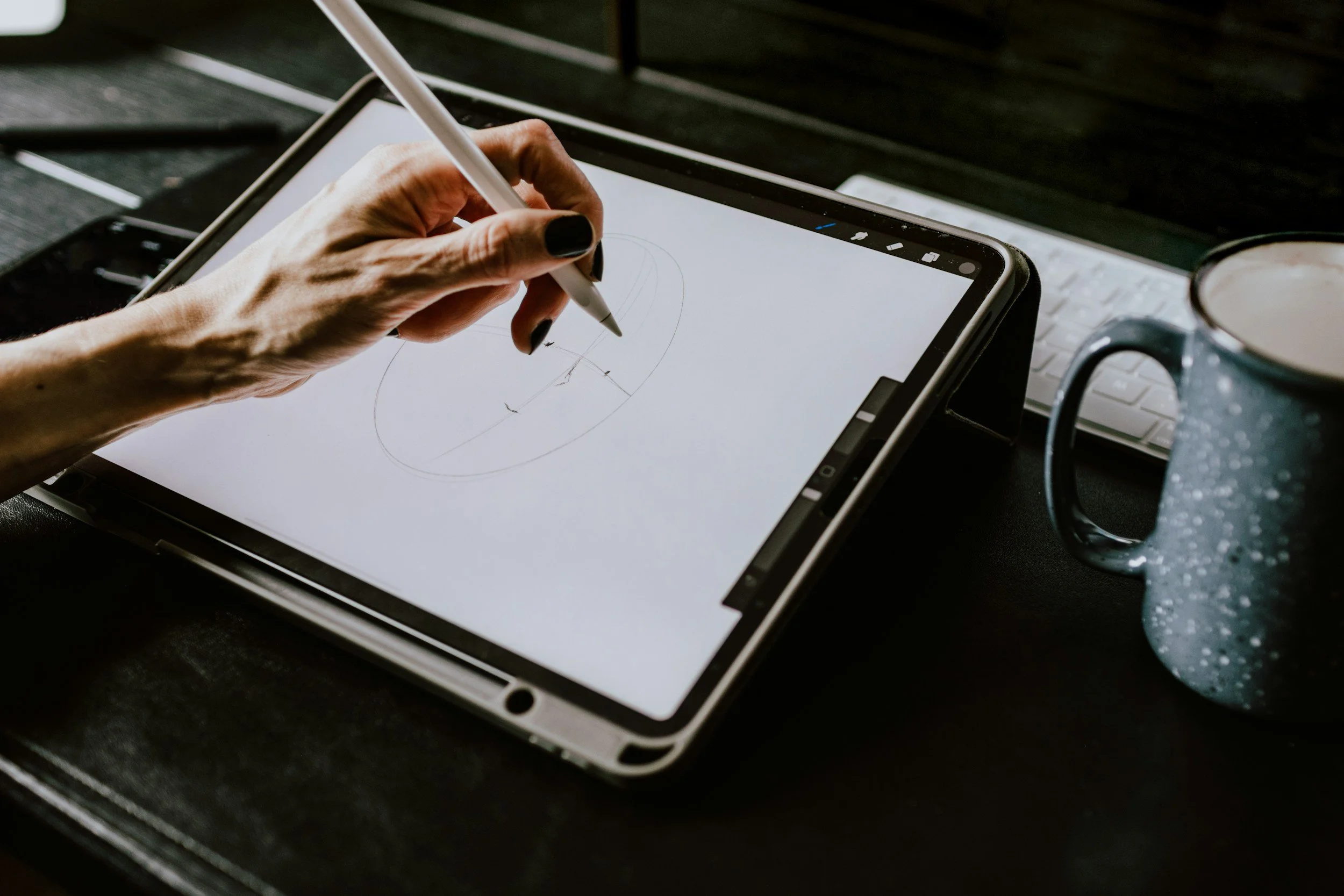
First, we need to be clear. We understand that "traditional art" isn't a single genre; it's a universe of practices, from drawing to sculpture, painting to printmaking. "Digital art" isn't one thing either. It's an entire parallel world of expression, with just as much breadth and just as many ways for an artist to find their voice. It ranges from digital painting that strives for the visual texture of oils, to complex 3D sculptures built for virtual spaces. It includes generative art, where the artist acts as an architect, designing a system that then helps create the work. And it encompasses immersive VR environments, interactive installations, intricate video collages, and the disciplined, rigorous craft of pixel art. It is not one medium; it is a multiverse of them.
In every one of these forms, the guiding force is the artist's consciousness. The "hand" isn't lost, it just manifests differently. We see it in the clear logic of a generative script, the structural decisions of a 3D model, or the precise pacing of a video edit. It is present in the deliberate mark made with a stylus, a gesture as intentional as any brushstroke. The labor, skill, and—most importantly—the intent are all profoundly human.
And yet, there is a barrier: that profoundly human skill is often invisible. This, I think, is a core source of the frustration. When we look at a painting, we can often trace the artist's decisions in the brushwork. We see the texture, the layers, the physical labor. We have a lifetime of context for what it means to apply paint to a surface.
With digital art, the craft is hidden. It’s buried in software, in non-intuitive processes, in hours of work that leave no physical trace. This opacity is not just a problem for the audience; it’s a barrier for other artists. Many art students, for example, avoid the medium precisely because it feels complicated and frustrating—an unappealing process of staring at a screen. This lack of interest in the making naturally translates into a lack of interest in the viewing. It's difficult to appreciate the craft in a digital piece when the process itself feels so alien.
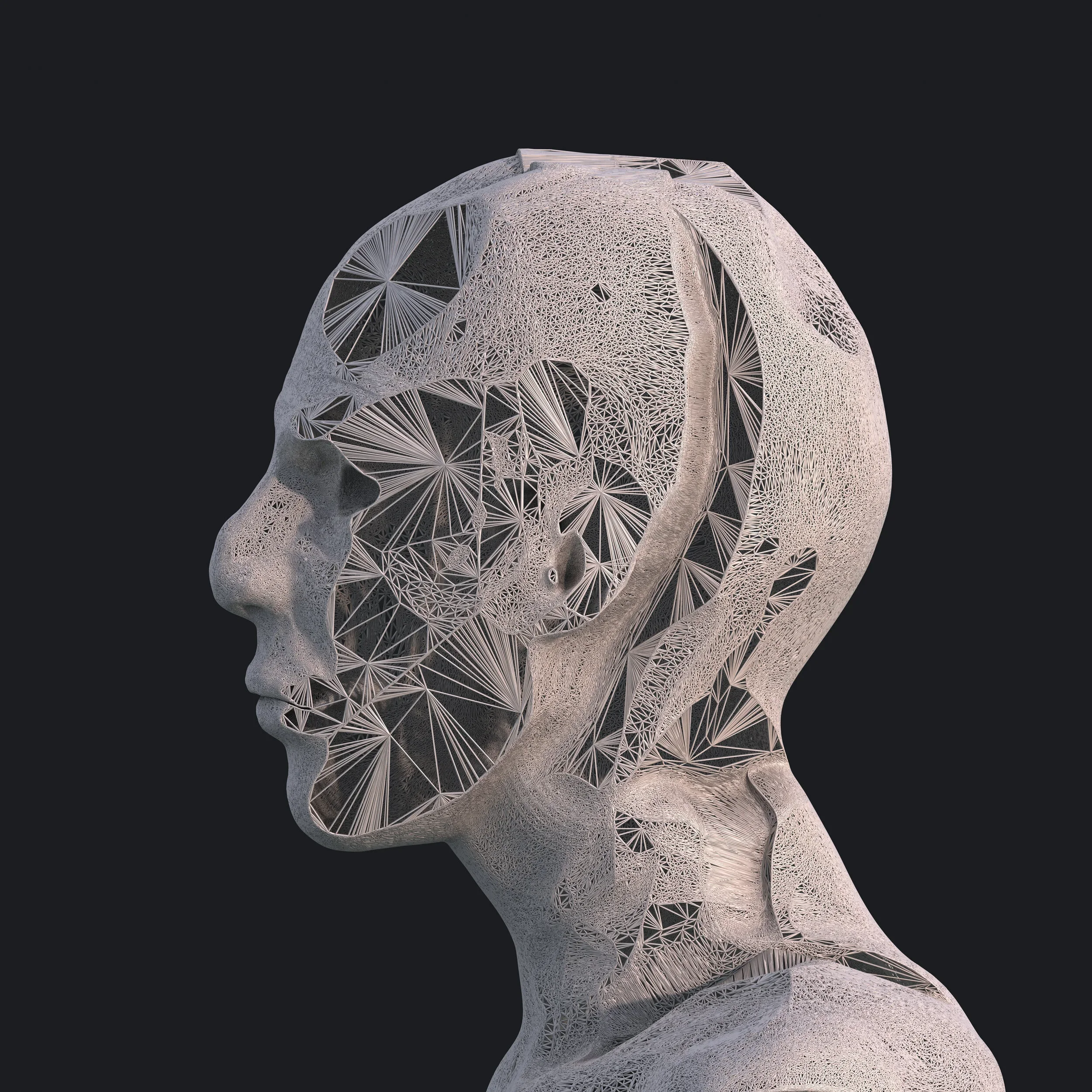
Artist: Espen Kluge
Perception
digital, 2013
www.espen.xyz
But this feeling of alienation is not new. Every significant new tool in art history was, at first, seen as a "cheat." The camera obscura was seen as a crutch for drawing. The invention of pre-packaged paint tubes in the 19th century was met with scorn by academicians, yet it was this very tool that liberated artists from the studio, enabling the Impressionists to paint outdoors and capture light in a revolutionary new way.
The most potent parallel, for me, is photography. When it emerged, the art world panicked. What was the purpose of a painter, they asked, if a machine could capture reality perfectly?
But photography did not kill painting. It liberated it. By freeing painting from the burden of pure representation, photography forced painters to ask new questions: "What can a painting do that a photograph can't?" The result was an explosion of modern art, from Impressionism to Cubism to Abstraction.
Digital tools offer the same liberation. They are not a threat to painting; they are a challenge to what painting can be. They absorb the tasks of pure technical mimicry, freeing the "traditional" artist to focus on the raw, physical qualities of paint itself, while the digital artist explores new frontiers of an unbound canvas.
This story of liberation by new tools is happening again, right now, with the rise of Artificial Intelligence. Just as photography freed painters from the burden of pure representation, AI tools are beginning to free artists from the burden of pure technical execution.
However, this liberation comes with a cost: volume. If photography democratized the image, AI has industrialized it. We are now facing a tsunami of generated content, a sheer quantity of imagery that threatens to drown out meaning entirely. This shift fundamentally alters the artist's role. It is no longer enough to be a creator; one must become a ruthless curator. In an age of infinite generation, the act of selection becomes the act of creation.
These profound challenges aren't a sign of the medium's weakness. They are a sign of its relevance. Good art has always reflected and challenged the moment it was made. These debates are the friction of culture shifting, and it is the artist's job to be at the center of that friction.
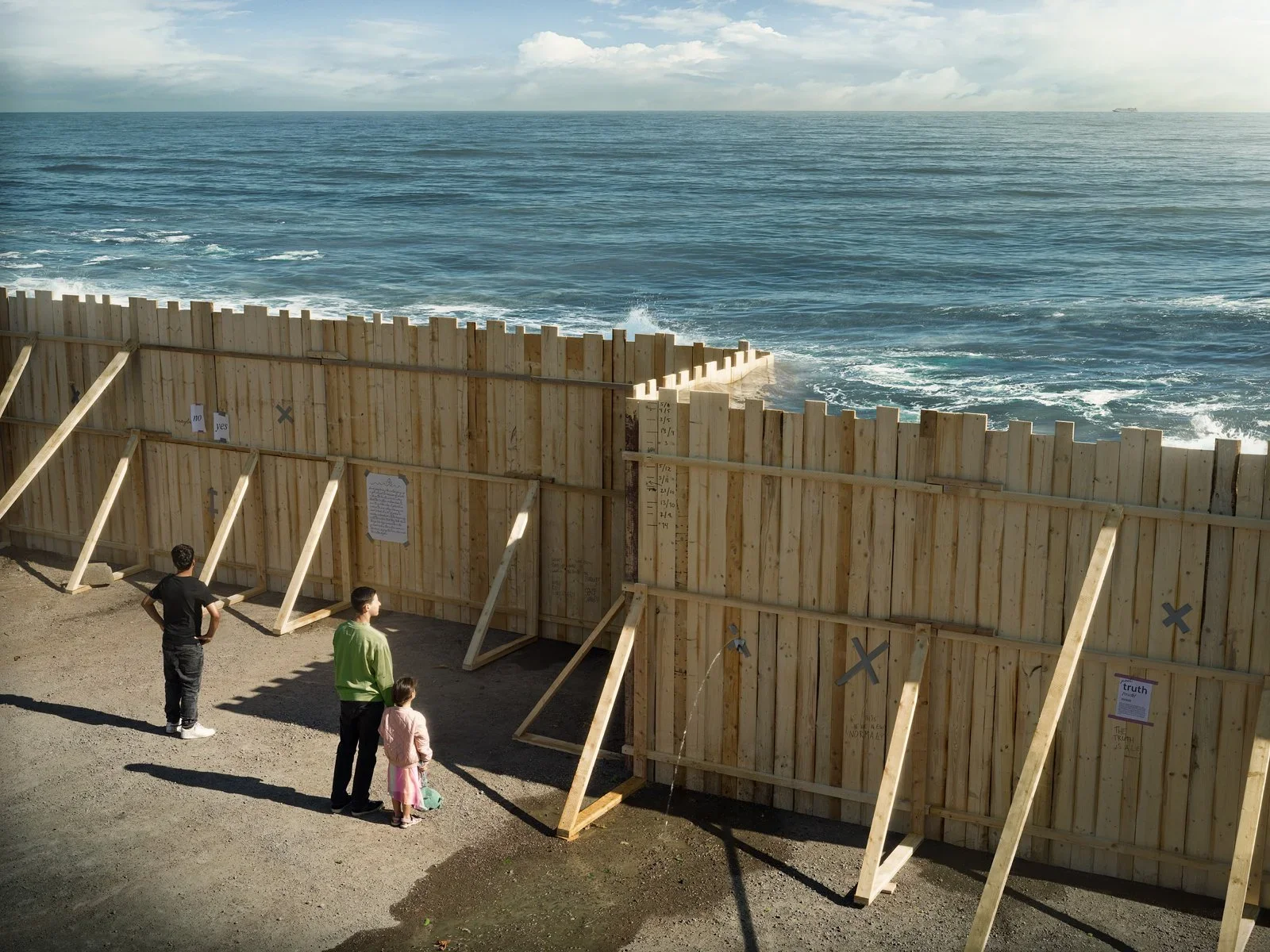
Artist: Erik Johansson
Level of Change
Digital, 2024
www.erikjo.com
The most common and most human criticism of digital art is its perceived lack of physicality. We are tactile, biological beings. We are evolved to value what we can touch and see in physical space—the canvas with its textured brushstrokes, the sculpture with its undeniable mass and presence in a room. We're drawn to the physical artifact. This is what the critic Walter Benjamin called the "aura" of an original work.
A digital file, infinitely reproducible, seems to possess no such aura. This specific anxiety is what drove the art world to adopt the blockchain in the form of the NFT. Stripped of the speculative frenzy, an NFT is simply a digital certificate of authenticity—a tool designed to impose singularity on the infinite. It was a technological attempt to engineer "aura," to prove that amidst a billion identical copies, this specific string of code is the one that matters. Regardless of the market volatility attached to them, their cultural impact was to assert that digital creation is distinct, ownable, and valuable in its own right.
This perspective helps us realize that we often confuse the art with its vessel. The art is the idea, the execution, the human expression. The "original" of a digital painting is the file itself. A high-quality print is not a "fake"; it is a manifestation of that original, just as a bronze cast is a manifestation of the sculptor's original clay model, or a photographic print is a manifestation of the negative. To insist that art must be a physical commodity is to value its scarcity more than its message.
There is, however, a darker consequence to this lack of physicality, one that fuels much of the public's fatigue: the absence of decay. In the physical art world, physics enforces a brutal but necessary form of curation. Bad paintings take up space. They gather dust. Eventually, if they are not valued, they are painted over or thrown away. The physical world has a natural garbage collector: entropy.
The digital world lacks this filter. Storage is cheap and effectively infinite. As a result, "bad" digital art—experiments that failed, sketches that went nowhere, or low-effort clutter—does not decompose. It accumulates. It circulates alongside the masterpieces, creating a deafening level of noise. This is the true challenge of the digital artist today. We are not just fighting for legitimacy; we are fighting against the sheer volume of our own medium. In a world where nothing disappears, the artist must impose the discipline that physics once provided.
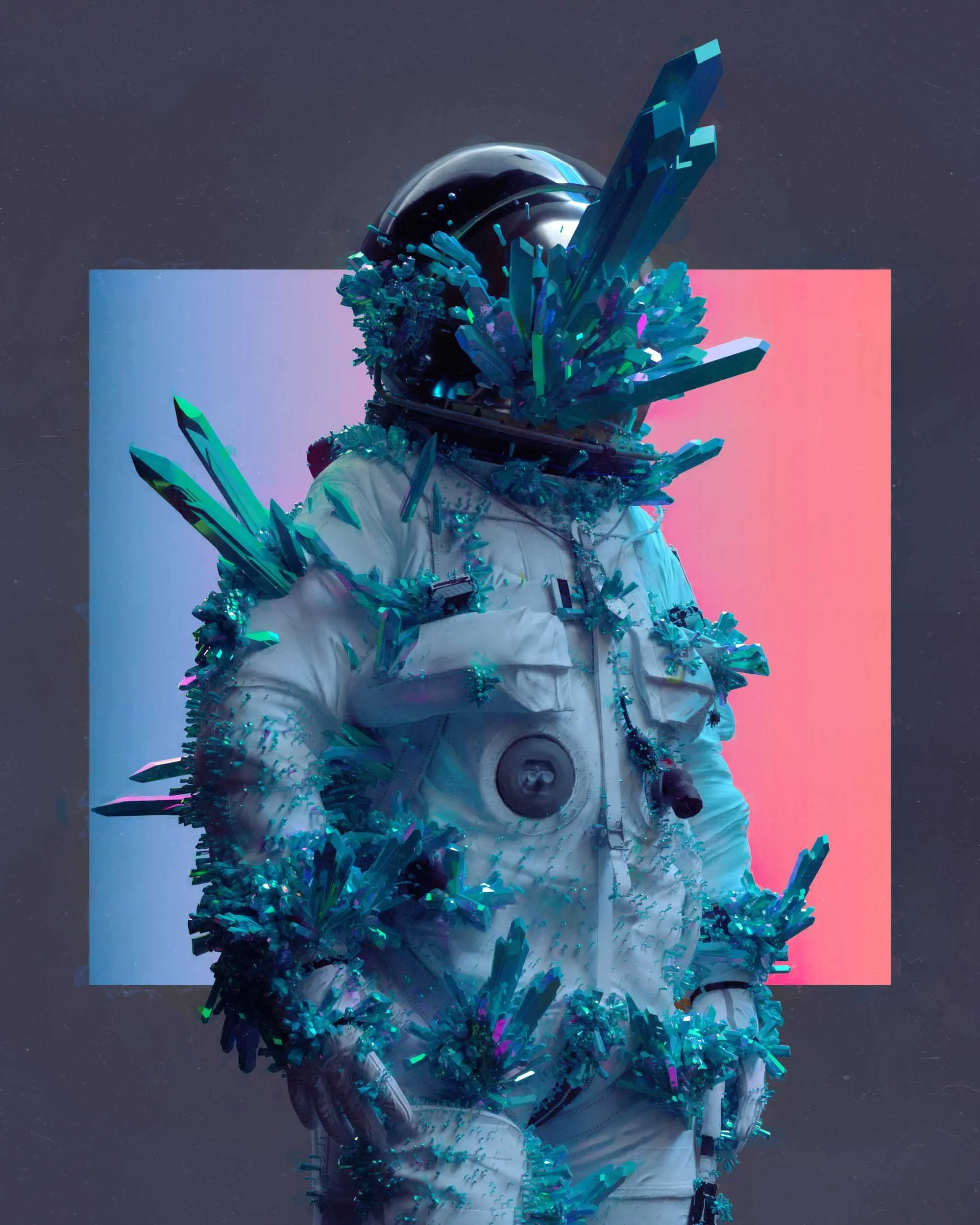
Artist: BEEPLE
Everydays, Round 13
Digital, 2019
www.beeple-crap.com
Finally, despite the noise, the digital medium remains a profoundly democratizing force. A traditional studio for painting, sculpting, and printmaking requires significant space, materials, and expense. A digital studio—with the power to paint, sculpt, animate, and edit—can exist on a single laptop or tablet.
This consolidation of tools is revolutionary. But the true revolution is in its distribution.
While a photograph of a traditional painting can be shared online, it is a reproduction—a ghost of the original. The digital artwork itself, the original file, can be distributed globally in its native form. Through decentralized platforms and blockchain verification, artists can now bypass the traditional gatekeepers of physical galleries entirely. This has radically diversified the voices, perspectives, and stories that can now define what "art" is.
This isn't about replacement. This is about expansion. It's about adding new instruments to the orchestra. To dismiss digital art is to dismiss the native language of the 21st century.
So, how do we change our perspective? We must stop judging the tool and start judging the art. We should ask the same questions of a digital piece as we would of any other: Does it have concept? Does it have craft? Does it make me feel? Does it make me think?
If we give it this chance, we will find the artist's hand is there, as present as ever. It is in the flow of the line, the choice of the color, and the soul of the idea. It is just waiting for us to look.
