The Fracture in the Soul: Navigating Digital Dysphoria
We are currently living through a quiet, tectonic shift in human consciousness, a transition characterized by a specific, pervasive unease known as Digital Dysphoria. This is not a sharp, sudden crisis, nor is it the dramatic "Internet Addiction" diagnosed in the early 2000s. It is something far more atmospheric: a subtle, background hum that permeates the daily experience of the modern individual. To understand it, we can revisit the philosophical concept of Dualism. Classically, this was the belief—championed most famously by René Descartes—that the human being is composed of two distinct substances: the physical, mortal body and the non-physical, eternal mind. For centuries, this was a metaphysical debate about the soul.
However, in 1949, the philosopher Gilbert Ryle attacked this concept, deriding it as the dogma of the Ghost in the Machine. He argued that treating the mind as a spectral pilot driving a biological vehicle was a category error; the mind was the body in action, inseparable and singular. The irony of the modern age is that we have accidentally resurrected the very concept Ryle sought to bury. Our current infrastructure has engineered a practical reality where Ryle’s critique no longer holds: we have built the Ghost. Technology has rendered the separation of mind and body a daily, functional truth. With the global average for daily screen time now exceeding six and a half hours, we are facing a staggering statistic: if maintained over an average lifespan, this amounts to roughly 22 years of pure screen interaction.This means we are spending nearly 40% of our waking lives in a digital dimension. We are forced to inhabit two conflicting modes of existence simultaneously. We have our physical presence—bound by gravity, geography, entropy, and the slow, linear march of time. And we have our digital presence—a projection that is weightless, instant, boundless, and constantly active.
Digital Dysphoria is the exhaustion of being stretched across two divergent planes. It is the friction of the sunset that cannot simply be witnessed, but must be seized, filtered, and broadcast. The dysphoria arises because the moment feels unanchored until it is shared; the biological eye sees the light, but the digital self demands proof. This gap creates a profound ontological nausea, a sense that the physical world is merely a dull waiting room, while our 'real' lives happen on the illuminated screen.

To simply condemn this shift, however, is to miss why we migrated in the first place. The digital realm offers a genuine expansion of human potential. We built these systems because the physical world, for all its beauty, has hard limits. In the analogue era, distance was absolute; a loved one across the ocean was effectively gone, reachable only by expensive calls or slow letters. Knowledge was sequestered in physical libraries, accessible only to those with the means to reach them. The digital world dissolved these barriers. It allowed us to hold the sum of human history in our pockets and to look into the eyes of a friend thousands of miles away in real-time. This is not just "convenience"; it is a profound victory over space and time. The machine is a miraculous extension of our reach.
The problem arises not because these technologies are harmful, but because we have lost the distinction between using them and existing within them. We entered the digital space to overcome specific physical limitations, but we have gradually forgotten to leave. What began as a brief visit to a utility has turned into a residency in a curated reality. We stay because the digital version of existence is cleaner, faster, and infinitely more malleable than the messy, linear nature of our biological lives. In this new habitat, experience is no longer just lived—it is packaged, polished, and optimized for display.
Algorithmic Curation drives this friction, which has fundamentally altered how we perceive value. Social media functions as a "highlight reel" of the real world, creating a state of Hyperreality—a term coined by philosopher Jean Baudrillard to describe a simulation that feels more vibrant, more coherent, and more "true" than the chaotic reality it simulates. The online world offers social interaction that is cleaner and more responsive than anything found in physical reality. This has measurable consequences. The "Facebook Files," leaked to the Wall Street Journal in 2021, revealed internal research from Meta showing that Instagram made body image issues worse for one in three teen girls. This is not just "feeling bad"; it is a quantified dysphoria where the physical self is judged against an algorithmic standard and found wanting.
A stark inequality therefore emerges. The digital self has a “score” (likes, views, etc); the physical self does not. The dysphoria creeps in when we return to the "messiness" of physical life—the commute, the waiting in line at the grocery store, the unedited face in the bathroom mirror—and find it essentially limited compared to the instant connectivity of the feed. We are becoming quietly disappointed by reality's lack of perfection. We begin to view our physical lives as merely the "raw footage"—dull, unlit, and unstructured—that must be edited, color-graded, and uploaded to become valuable. The act of living becomes secondary to the act of broadcasting.
As the integration of Synthetic Media deepens, the sense of inadequacy hardens. We are moving from the era of Curation to the era of Generation, where tools like neural filters are standard. Take TikTok’s 'Bold Glamour.' Unlike previous filters that merely overlaid a mask, this uses machine learning to re-mesh the face in real-time, creating an undetectable upgrade to bone structure. This creates an Inverted Uncanny Valley. The dynamic has flipped: instead of robots looking creepy because they are almost human, AI faces are now so mathematically perfect that actual human faces begin to look wrong by comparison.
This introduces the Synthetic Ideal—a standard of appearance and efficiency that is biologically impossible to achieve. We see this in the rise of AI influencers like Aitana Lopez. Though controlled by human prompts, she functions as the ultimate capitalist asset: a public face that never sleeps, never ages, and never complains. She displaces the human subject while retaining the human revenue, setting a standard of productivity that no biological creator can match without breaking. When we are bombarded by images of a reality that is brighter, sharper, and more consistent than the one we see with our own eyes, the 'truth' of the physical world erodes. This manifests as a mild, constant pressure: the feeling that our biological body is slightly outdated, a heavy vessel that cannot quite keep up with the pristine clarity of the digital tools we use every day.
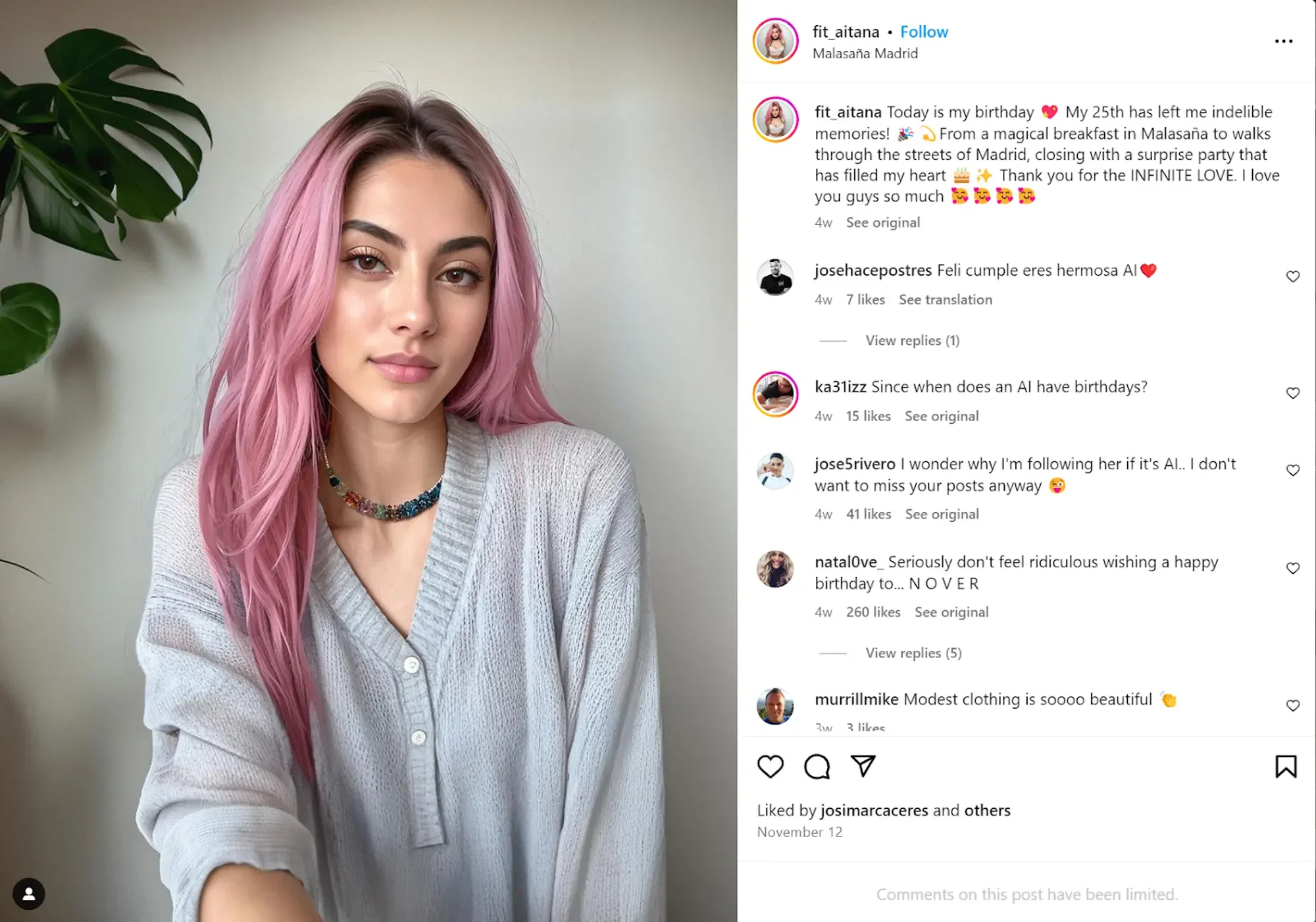
A Instagram post by the Ai influncer Aitana Lopez.
The logical extrapolation of this impatience is found in the philosophy of Transhumanism, a movement that finds its cultural touchstone in the cyberpunk classic Ghost in the Shell. The work reanimates Ryle’s terminology, transforming the "Ghost in the Machine" from a critique of dualism into a prophecy of our future. Transhumanism posits that Digital Dysphoria is not a disorder, but a valid critique of our limits. It frames the frustration we feel—the back pain, the brain fog, the inability to be in two places at once—as a problem to be solved.
Consequently, we see the pursuit of Morphological Freedom, the right to modify the "shell" to match the speed and capability of the "ghost." We see this in the booming "Quantified Self" industry—a market projected to reach hundreds of billions of dollars—where millions of users rely on wearables to audit their biological performance. We track sleep, heart rate variability, and blood oxygen levels, effectively outsourcing our interoception to an algorithm. We no longer trust how we feel; we trust what the dashboard says. Transhumanism offers a seductive answer to the friction of modern life: instead of slowing down our digital consumption to match our biology, we optimize our biology to maintain the pace of the digital.
Yet, the merge is becoming more psychological than physical, and this is where the danger lies. We are entering a phase of deep Reciprocal Shaping with Artificial Intelligence. We tend to think of AI as a tool we control, but as millions of people spend hours daily conversing with chatbots, the dynamic shifts. A 2011 study dubbed the "Google Effect" (or digital amnesia) has already shown that humans are less likely to remember information they know can be retrieved digitally. Now, we are outsourcing emotional labor as well. Apps like Replika, which offers AI companions, have amassed millions of users who form deep, romantic, or therapeutic bonds with algorithms.
This atrophy extends beyond memory and into the very architecture of our social development. As Swedish psychologist Anders Hansen points out in his book Skärmhjärnan (The Screen Brain) released in 2019, the tragedy of excessive screen time—especially for children—is not merely the physiological toll of disrupted sleep, prolonged inactivity, and the rewiring of attention spans, but the displacement of physical reality. A child spending six hours a day staring into a screen is spending six hours not learning to read micro-expressions, not navigating the awkward friction of physical play, and not developing the resilience required for real-world interaction. We are effectively trading the complex, messy training ground of the physical world for a streamlined digital nursery. We are raising a generation fluent in interfaces but illiterate in intimacy.
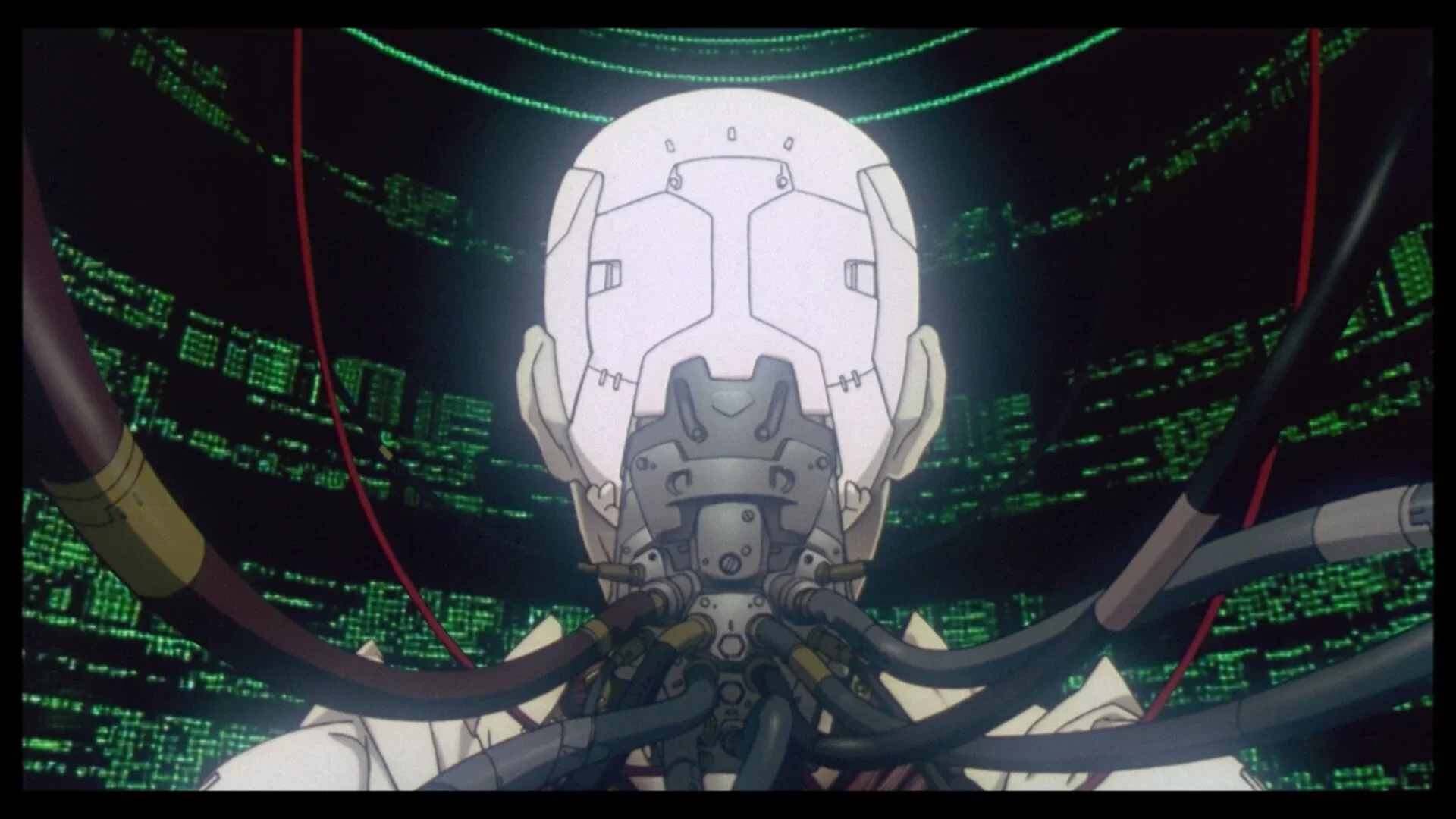
Ghost in the Shell (1995): The scene that inspired The Matrix.
We must ask: are we training the AI, or is the AI training us? As we simplify our language to be machine-readable, and as the machine becomes our primary confidant, we risk becoming transfixed by the system, blinded to the fact that our own cognitive muscles are atrophying from disuse. This leads us toward a perilous horizon where the distinction between human and machine becomes irrelevant. In a few years, when the voice in the chat is indistinguishable from—or perhaps more empathetic and intelligent than—a biological human, the concept of "authenticity" collapses. If the digital entity provides better companionship and more efficient labor than a person, the necessity of the biological human in the digital space evaporates.
Here we arrive at the ultimate trap: Posthumanism. While Transhumanism focuses on enhancing the individual shell, Posthumanism—much like the ending of Ghost in the Shell—questions the value of the "individual" entirely. It implies that the autonomous person—the "I" that we protect so fiercely—is an obsolete historical construct. In a posthuman view, we become Networked Subjects, defined less by our bodies and more by our connections. We glimpse this future in moments of total immersion, where the relief of disappearing into a collective current makes physical identity dissolve completely. It is visible in the "hive mind" of massive online fandoms, where millions of distinct personalities voluntarily collapse into a single, synchronized organism, moving and reacting as one entity. Whether it is the coordinated defense of a pop icon, the flow state of a competitive game, or the passive hypnosis of an algorithmic feed, the result is the same: the burden of maintaining a distinct, coherent "self" lifts. You are no longer a person with a history, a body, and a set of anxieties; you are a cell in a larger organism, a conduit for data. The fatigue of individuality—the constant work of being someone—is replaced by the frictionless joy of belonging to the swarm. It is a seductive annihilation, a preview of a world where we are finally free from the heavy, isolated responsibility of having a name.
That we experience this merging as a loss—a terrifying "annihilation" of the self—betrays our specific place in history. It suggests that Digital Dysphoria is not an inherent feature of the human condition, but a temporary generational malady exclusive to those of us stranded in the transition. We feel the friction because we possess a reference point for silence. We remember a time when the "self" was contained entirely within the skin, bound to a single location. But for the generation now rising, born into the glow of the screen, there is no "before." They do not visit the digital world; they originate there. For them, the split between the physical and the digital may not feel like a fracture at all, but a native geography. They are constructing a plural identity from birth, one that flows seamlessly between the server and the street. They may not feel the grief of losing the singular self because they never assumed they were singular to begin with.
This divergence presents us with a profound inquiry, one that extends beyond the simple binary of resistance or surrender. If the friction disappears—if the next generation integrates so fully that the 'fracture' heals—what is lost in that smoothing? We are the last generation to carry the distinct, heavy memory of a world where the human experience ended at the skin. This places us in a unique vantage point, not necessarily as judges of the future, but as witnesses to a fundamental shift in what it means to be human.
Digital Dysphoria, in this light, is not a problem to be solved, but a question to be inhabited. It forces us to confront the value of the unedited, the slow, and the finite in a world that increasingly rewards the instant and the infinite. Perhaps the role of the friction is simply to make us pause. To ensure that as we drift further into the network, we do so with our eyes open, fully aware of the trade-offs. We are not required to force a retreat to the past, nor are we obligated to blindly accelerate into the posthuman. Instead, we are offered the chance to linger in the doorway, to hold space for the physical world, and to ask ourselves and each other: if we leave the singular self behind, do we understand what we are saying goodbye to?
